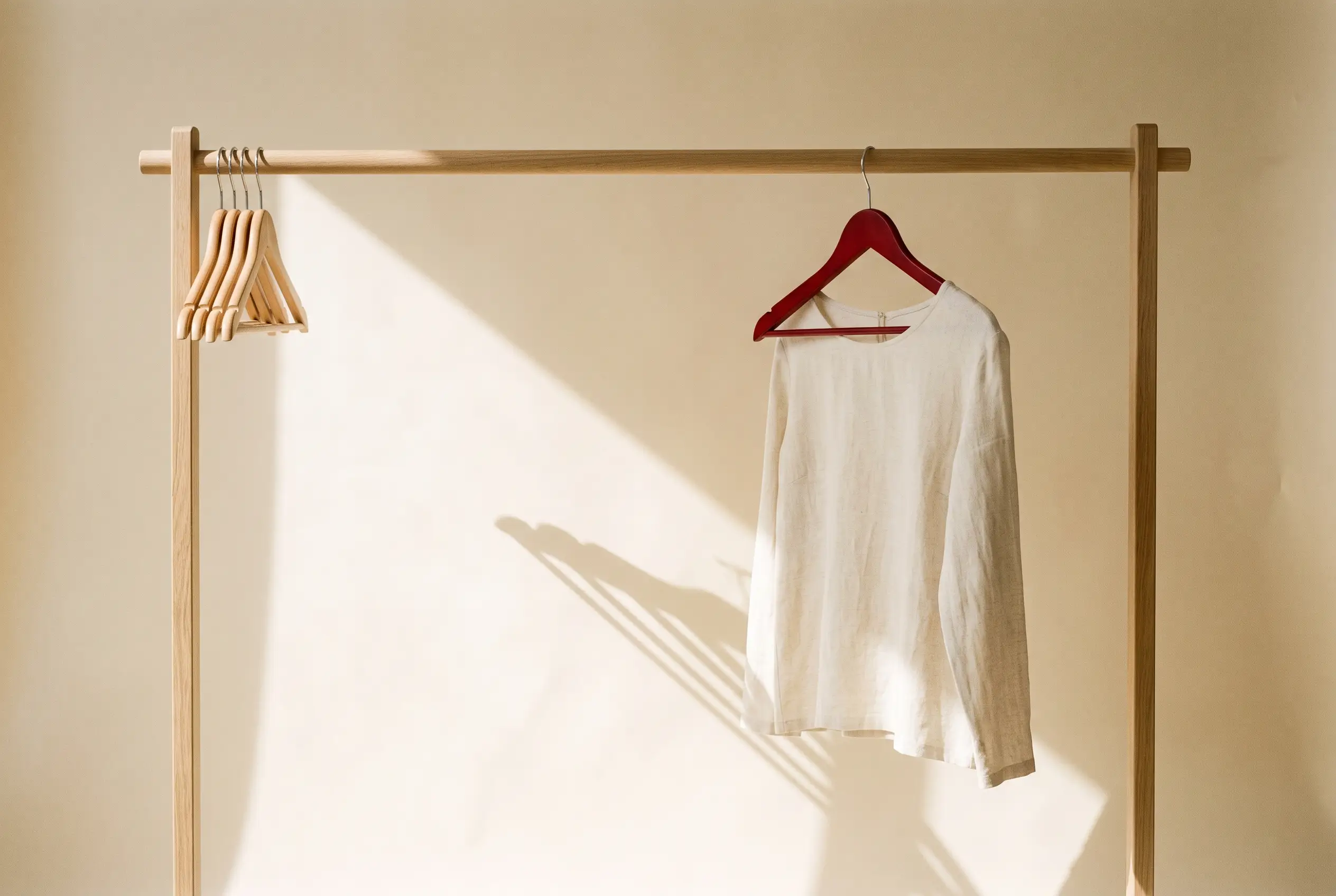
Most closets are not too small. They are too loud — crammed with options bought for a version of you that never quite showed up.
A wardrobe audit is really an audit of decision-making. Every unworn blazer, every "just in case" dress, is a decision deferred rather than made. Strip a closet down to forty pieces — not forty outfits, forty individual items total — and you remove the option to hide behind volume. You are forced to know, precisely, what you own, what fits, and what you reach for when a room actually matters.
Why Forty Is the Number That Works
Forty is not a magic number so much as a practical ceiling. Below it, most people still have room for the basics that matter — a handful of tops, a few bottoms, a coat or two, shoes for the seasons you actually live through. Above it, the closet tips back into noise. The exact count matters less than the exercise of arriving at one. A hard limit forces trade-offs, and trade-offs are where taste actually develops. Anyone can accumulate. Curating requires a point of view.
Decision fatigue is real, and it compounds across a day. Every unnecessary choice eliminated at seven in the morning is cognitive bandwidth returned to you by three in the afternoon. A wardrobe that fits in a single glance — instead of a closet you have to search — removes one more decision from a day that already has too many.
The Discipline Behind the Number
Cutting a wardrobe to forty pieces runs on the same discipline that governs any well-managed system: eliminate the noise, keep what is essential, stop carrying forward what no longer serves the current period. I'd argue that logic holds for a closet, a calendar, or an inbox in equal measure. Abundance is not the same thing as security, and volume is not the same thing as style. A closet with forty considered pieces reads as more put-together than one with two hundred impulsive ones, every time.
Enough is not a number. It is a decision about who you are when no one is watching what you're wearing.
Here is what the exercise forces, once you commit to it:
- You stop shopping for a hypothetical life and start dressing the one you are actually living.
- Your personal style sharpens, because you can no longer use quantity as a substitute for a point of view.
- You spend less — not from deprivation, but because you already own what you need.
- Getting dressed stops being a negotiation and becomes a habit, which frees up energy for decisions that actually deserve it.
Start With Subtraction, Not Addition
Most capsule wardrobe advice starts with a shopping list: buy these twelve foundational pieces, in these colors, in this fabric. That is backwards. Start by removing, not acquiring. Pull everything out of the closet. Keep only what you have actually worn in the last year and what genuinely fits the life you are living now — not the one you were living five years ago, and not the one you are hoping to live five years from now. What remains is your real wardrobe. Everything else was inventory, not identity.
Once the closet holds only what you actually wear, the gaps become obvious, and they are almost always smaller than you expect. Fill them deliberately, one considered piece at a time, rather than restocking out of habit. Buy for fit and durability over trend — a wardrobe built to last past one season is a wardrobe you will not need to think about twice.
What You Get Back
The real return on a smaller wardrobe is not tidiness. It is the mental space that opens up when getting dressed stops requiring a decision. That space does not stay empty. It gets redirected toward the parts of the day that actually require your judgment — the meeting, the conversation, the work in front of you. A capsule wardrobe is not a restriction. It is clarity, worn daily, and it tends to look better on you than the closet it replaced ever did.