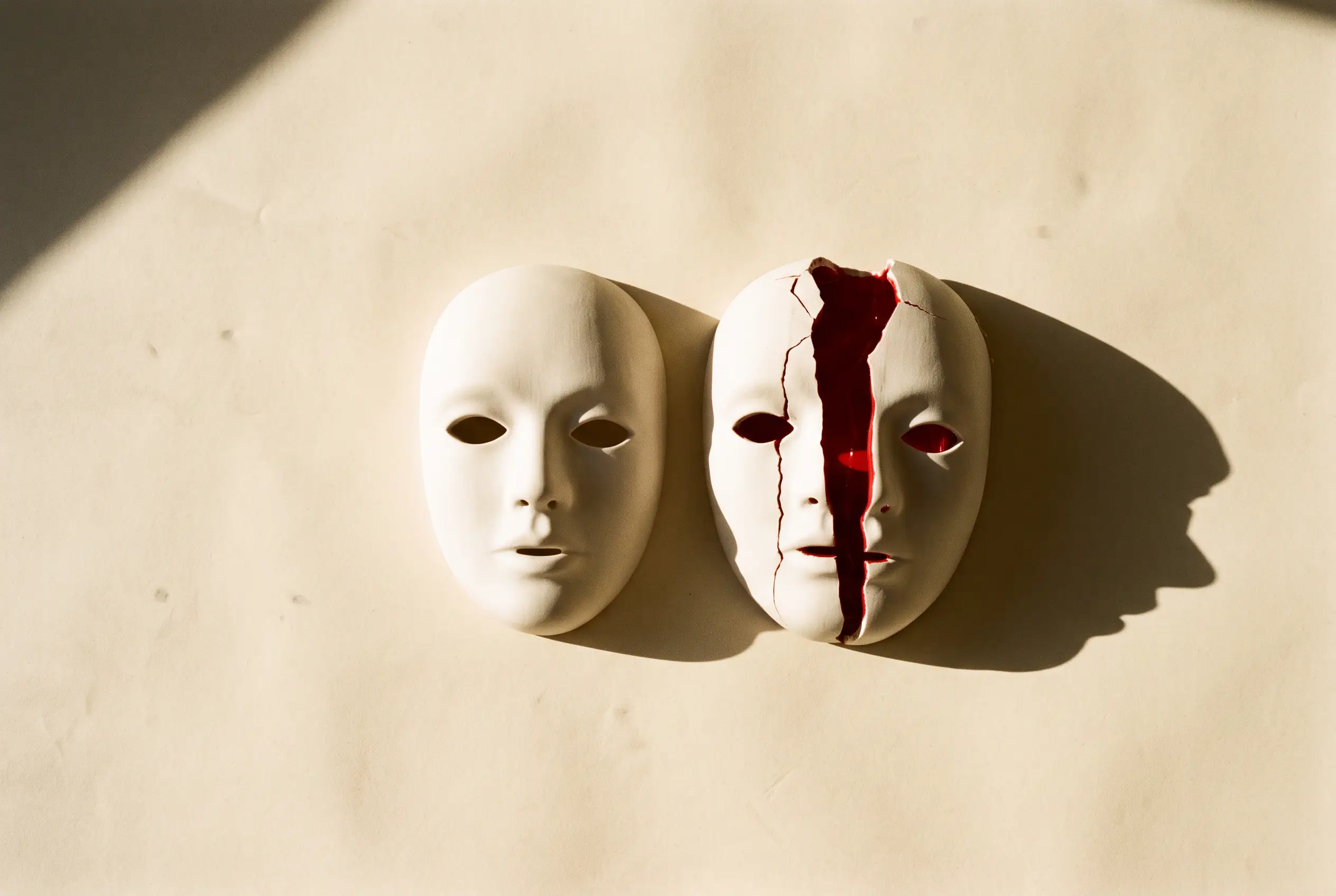
Performed confidence and real confidence look identical from across the room. They feel nothing alike from the inside.
Most professional confidence is borrowed. It comes from titles, from rooms you've earned the right to enter, from other people's recognition. It needs constant feeding — a win, a compliment, a promotion — or it starts to wobble. Plenty of people spend entire careers performing certainty they don't actually feel, because the alternative, hesitating in a room that rewards speed, feels more dangerous than the performance itself.
Then something arrives that the performance can't survive. News you didn't see coming. A loss that reorganizes every priority you thought was fixed. A single piece of information that changes the shape of the next several years. And the costume, whatever it was built from, dissolves in about forty-five seconds.
The Waiting Room Teaches You Everything
There is a particular quality of silence in a room where people are waiting for news that will change everything. It is not peaceful. It is the silence of people doing arithmetic on time — not the clean, solvable kind, but the open-ended, variable kind that refuses to balance. Sit in that silence long enough and you understand something you can't unknow afterward: you cannot model your way out of every problem. No forecast, no contingency plan, no version of the spreadsheet where the numbers behave.
Fear, before a moment like that, tends to live in the future tense — hypothetical, manageable, theoretical. After, fear becomes specific. It has a name, a timeline, a set of facts attached to it. And something strange happens when fear gets that concrete: it becomes survivable. Not easy. Not small. But survivable. You can work with a known quantity. It's the vague ones that hollow you out.
Before the crisis, the fear was about failing. After it, the fear was about something that made failing look almost quaint.
What Survives the Stripping Away
Here is what tends to remain once the performance burns off:
- Performed confidence protects your ego. Real confidence protects your judgment.
- A boardroom stops feeling like a stage once you've sat somewhere with genuinely higher stakes. Stakes have a hierarchy, and clarity arrives once you finally know yours.
- Courage was never the absence of fear. It was the decision that the work still mattered more than the fear did.
- Numbers under pressure tell the truth. So do people. A real crisis is pressure of the highest order, and it tends to introduce you to yourself without the performance running interference.
The Confidence That Stays
New confidence, the kind that survives a genuine test, does not need an audience. It doesn't arrive with an entrance. It shows up quietly on the worst morning of your life and, for reasons that are hard to explain to anyone who hasn't lived through the equivalent, it simply does not leave afterward. It is quieter than the old kind and considerably more useful in a room that actually matters.
None of this is gratitude for the crisis itself — that particular narrative deserves to be refused. It's something closer to inventory: the knowledge that you have already faced the worst version of "what if" and you did not disappear. You kept showing up. You kept doing the work. You kept telling the truth in rooms that would have preferred a comfortable fiction.
That is not performance. That is the real thing. And it usually takes losing every hypothetical fear to finally find it.