Flour tells the truth. It cannot be rushed, negotiated with, or optimized into submission — a fact that becomes obvious the moment you stand at a floured table in Bologna and try to turn a pile of 00 flour and two cracked eggs into something worth eating.
Most hand-rolled pasta classes in Bologna start the same way: a mound of flour, a well pressed into its center with two fingers, eggs cracked in, and one instruction. Work. No machine, no shortcut, no measuring cup. Just the slow math of flour absorbing egg, one fold at a time.
The Dough Does Not Care About Your Confidence
Kneading pasta dough rewards patience in a way almost nothing else in modern life does. You cannot power through it. The dough responds to sustained, even pressure — the heel of the palm pressing forward, a quarter turn, a fold, and again, for a solid ten minutes, sometimes twenty if the flour is stubborn or the air is dry. Rush it and you get something technically edible and structurally joyless: dough that tears when rolled, strands that turn gummy in the pot.
What makes traditional Bolognese technique different from a home cook's shortcut version is the resting time. The dough needs at least thirty minutes wrapped tightly, undisturbed, before it will roll thin without fighting back. Skipping this step is the single most common reason home-rolled pasta turns out tough. The gluten needs time to relax, not more force.
Rolling, Cutting, and the Case Against the Machine
A hand-cranked pasta machine will get you consistent sheets faster than a rolling pin ever will. But the traditional Bolognese mattarello — a long, thin, dowel-style pin with no handles — produces a texture a machine cannot replicate: a slightly rough, porous surface that holds sauce instead of shedding it. This is the actual argument for hand-rolling, and it has nothing to do with romance. Sauce clings to imperfection. A perfectly smooth, machine-extruded noodle is often a worse noodle.
The rolling pin is not decorative. It is a tool built for one purpose: even, continuous pressure from the center outward, turning the dough a quarter-turn between passes so it never overworks in one direction.
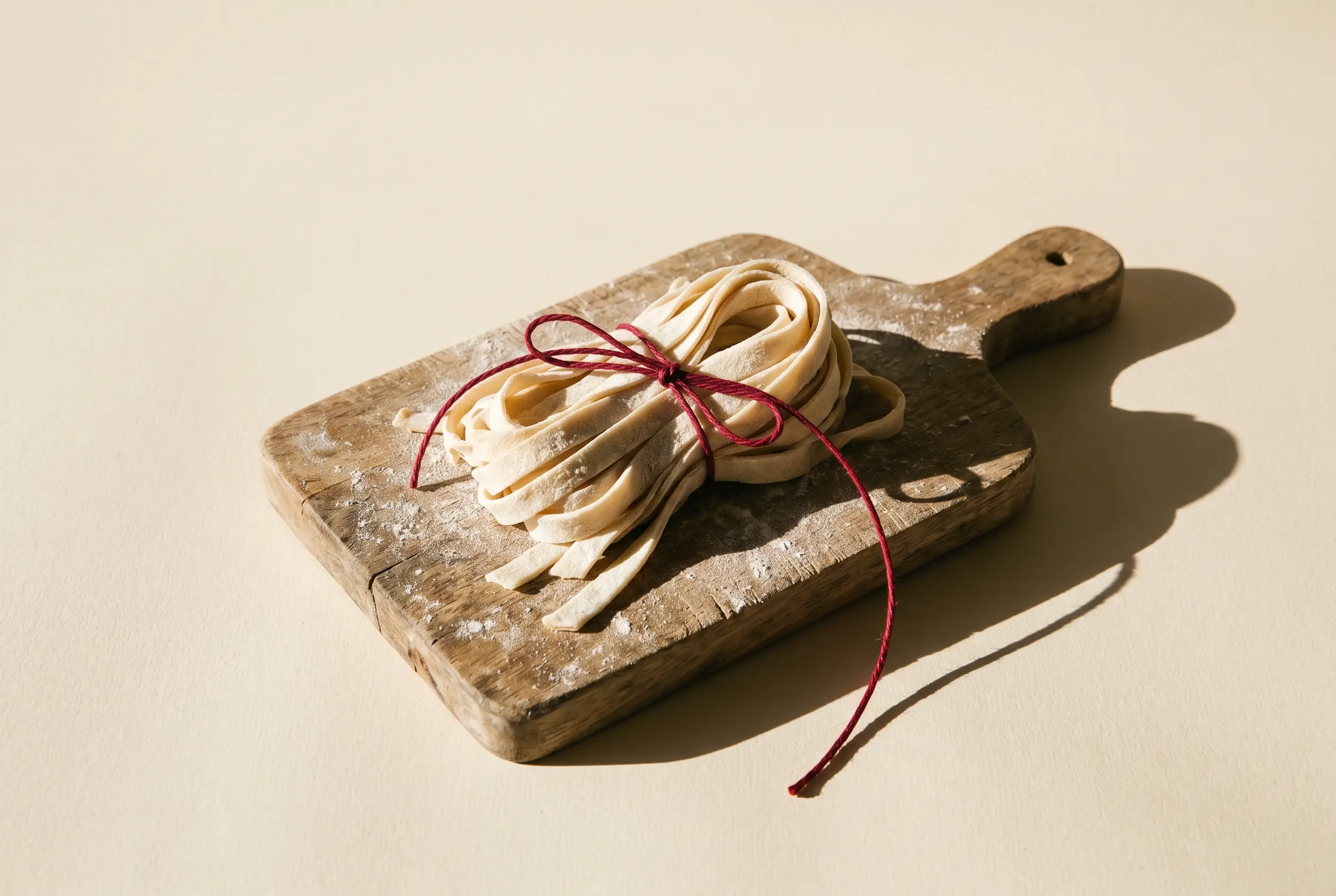
For tagliatelle, the classic cut of the region, the sheet gets rolled thin enough to see a shadow of your hand through it, then loosely folded into a flat coil and sliced into ribbons about a quarter-inch wide. Uneven strands are not a flaw — they are the signature of hand work, and they cook slightly differently strand to strand, which is part of the texture, not a defect to fix.
What This Technique Actually Teaches
There is no shortcut version of this that produces the same result. Efficiency is beside the point of hand-rolled pasta; the process itself is the product. That is a useful thing to sit with in a culture that treats speed as a virtue by default. Some tasks are worth doing slowly on purpose, not because slowness is sentimental, but because the technique genuinely requires it.
If you are planning a trip built around this kind of hands-on cooking class, a few practical notes make the experience better:
- Book a class with a small group size — pasta technique is taught hand-over-hand, and a class of twenty means you barely touch the dough.
- Ask whether the class uses a wooden board and pin or a pasta machine. If the listing does not specify, assume machine and ask directly if you want the traditional method.
- Bring home a wooden rolling pin if you find a good one at a local market stall — it is the one tool that actually changes how your pasta turns out at home.
- Expect your first sheet to be uneven. That is normal, not a sign you are doing it wrong.
The technique itself is simple enough to describe in a paragraph and difficult enough to take years to get right — which is exactly why it is still taught by hand, table to table, in a city that has never seen a reason to modernize a method that already works.