Kuku sabzi is not a pretty dish in the Instagram sense. It's beautiful the way honest things are beautiful — dense with herbs, dark and almost crackling on the outside, impossibly green and yielding within.
The dish sits at the center of the haft-sin table, the ceremonial spread prepared for Nowruz, the Persian New Year that arrives with the spring equinox — not a symbolic fresh start but an astronomical one, timed to the exact moment the sun crosses the celestial equator. The green of kuku sabzi is not decorative on that table. It stands for rebirth, and it is meant to be the most abundant, most alive thing in the room.
Versions of the dish vary by household and region — some cooks add barberries for tartness, others skip the walnuts entirely, and the ratio of herbs shifts depending on what's fresh and abundant that week. What stays constant across nearly every version is the principle: the herbs are the dish, and the eggs are only there to hold them together.
The Ratio That Actually Matters
What surprises most people the first time they make it is how incidental the eggs are. This is not an egg dish with herbs folded in — it's an herb dish, barely held together by eggs. Get the ratio backwards and you end up with a frittata that happens to be green, instead of the real thing.
A workable base: three cups of packed parsley, two cups of cilantro, one cup of dill, and half a cup of finely cut chives. Four eggs. A whisper of turmeric. Fenugreek if you can find it, walnuts and barberries if you want the older, more elaborate version served in some households. Weigh or pack the herbs generously — this is the one place in the recipe where more is correct.
- Parsley — the backbone, reliable and slightly bitter, holding the shape of the whole dish.
- Cilantro — divisive and bright; trust the version of this recipe that includes it.
- Dill — delicate and insistent at once.
- Chives — a subtle heat underneath everything else.
The Method
Wash and dry the herbs thoroughly — any residual water will steam the kuku instead of letting it fry properly, and a soggy kuku sabzi is the most common failure point. Chop them fine, by hand or in short pulses in a food processor, being careful not to purée them into paste. Whisk the eggs separately with the turmeric and a generous pinch of salt, then fold in the chopped herbs until the mixture looks more like herbs bound by egg than the reverse.
Recipes are just someone else's memory. You cook them until they become your own.
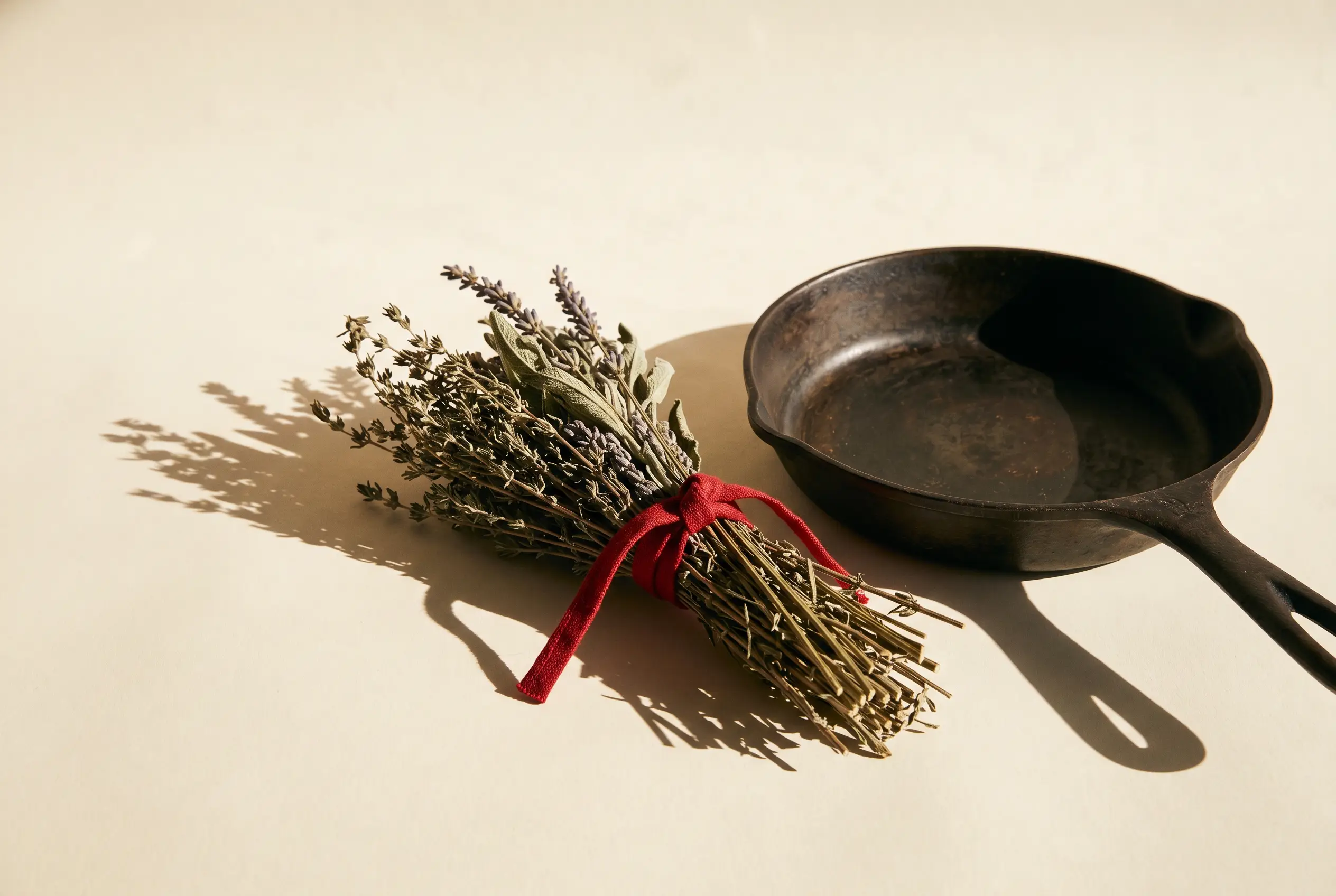
Heat oil in a well-seasoned cast iron or nonstick pan until it shimmers. Pour in the batter, cover, and let it cook low and slow until the bottom is deeply golden and the top has mostly set — this takes longer than most frittata recipes suggest, often fifteen to twenty minutes on gentle heat. Flip it in sections if a full flip feels risky, or invert it onto a plate and slide it back into the pan to finish the second side. The goal is a dark, almost crisp exterior with a green, tender interior that holds together when sliced.
Serving It Right
Kuku sabzi is traditionally served at room temperature, cut into wedges or squares, alongside flatbread, fresh herbs, and a bowl of thick yogurt. It holds well for days and, like many dense vegetable dishes, tends to taste even better on the second morning. Serve it as part of a haft-sin spread if you're marking Nowruz, or simply as a green, herb-forward dish worth making any time the season calls for something that tastes unmistakably alive.
However you make it, resist the urge to thin out the herbs to save time. The dish only works when it feels almost too full of green to hold its own shape — that density is exactly what centuries of home cooks have been getting right about renewal: it asks you to plant abundantly, not sparingly.